
Quick answer: how do you get insurance to pay for a roof replacement?
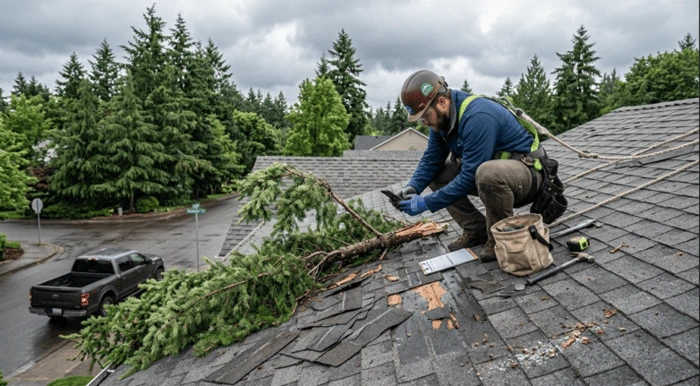
Homeowners insurance pays for a roof replacement when a sudden, covered event (windstorm, falling tree, hail, fire, or heavy snow load) damages the roof badly enough that repair is not practical. It does not pay to replace a roof that is simply old, worn out, or neglected.
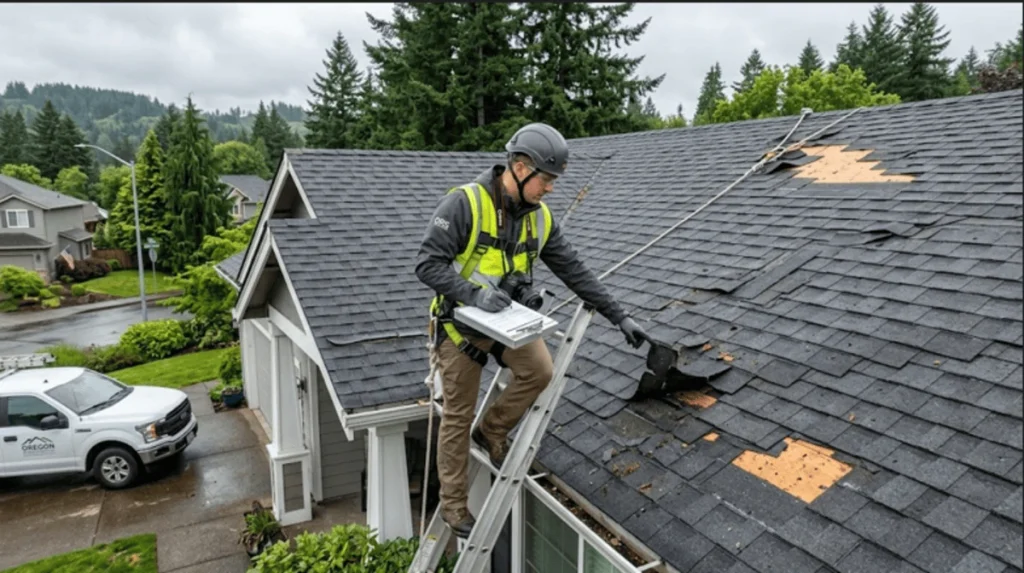
To get a claim approved, follow these five steps:
- Read your policy to see whether your roof is covered at replacement cost value (RCV) or actual cash value (ACV), and what your deductible is.
- Document the damage right away with dated photos and video, from the ground and the attic.
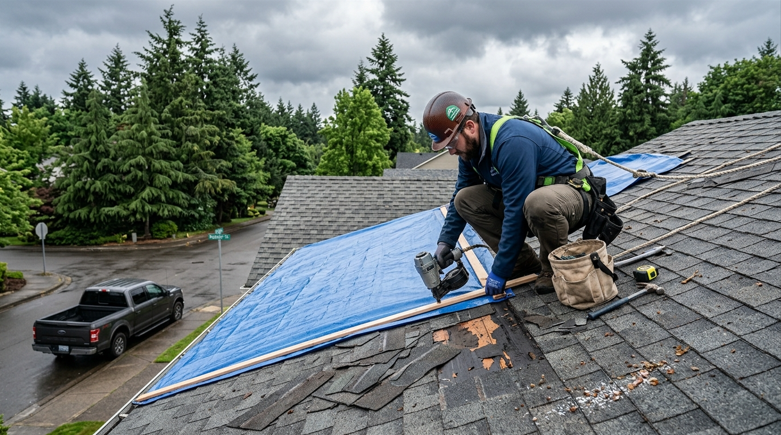
- Prevent further damage with an emergency tarp, and keep the receipts.
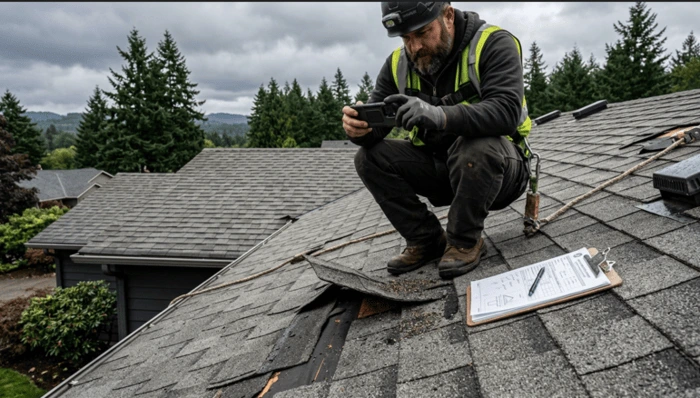
- Get a licensed roofer’s inspection report before or alongside filing the claim.
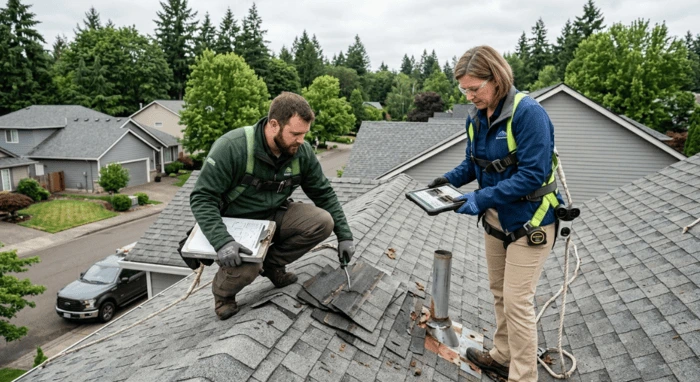
- File the claim promptly and have your roofer present when the insurance adjuster inspects the roof.
In Oregon, the most common reasons roof claims are denied are wear and tear, moss and long-term water damage, and damage reported too late. The rest of this guide explains each step in detail.
Does homeowners insurance cover roof replacement?
Yes, but only when a covered peril causes the damage. Most Oregon homeowners have an HO-3 policy, where the roof is part of the dwelling coverage. That coverage pays for sudden, accidental damage, not for a roof that has worn out over time.
| Usually covered | Usually not covered |
|---|---|
| Windstorm damage (lifted or missing shingles) | Normal wear and tear, old age |
| Trees or large limbs falling on the roof | Moss growth and the rot it causes |
| Hail damage | Slow leaks that went unrepaired for months |
| Heavy snow or ice load causing collapse | Poor installation or workmanship |
| Fire and lightning | Damage from pests or rodents |
| Ice dams (often covered, check your policy) | Earthquake and flood, unless you bought separate coverage |
In the Sandy and Mount Hood corridor, we see the most approved claims from winter windstorms, falling fir limbs, and heavy snow. We see the most denials from moss damage and long-term leaks, because insurers treat those as maintenance problems.
If your roof is simply old, insurance will not replace it. Some home warranties cover age-related roof problems, but read the limits carefully.
How much will insurance pay for a new roof? ACV vs. RCV
How much you receive depends on whether your policy pays replacement cost value (RCV) or actual cash value (ACV), minus your deductible. Look for these terms on your declarations page or ask your agent.
| Replacement cost value (RCV) | Actual cash value (ACV) | |
|---|---|---|
| What it pays | Cost of a new roof today, minus your deductible | Depreciated value of your old roof, minus your deductible |
| Does roof age matter? | Less so | Yes, a lot: older roofs are worth less |
| How payment works | First check for ACV, then the held-back “recoverable depreciation” after the work is done | One check; no more money later |
| Out-of-pocket for you | Usually just the deductible | Deductible plus the depreciation |
Example: A storm damages a 15-year-old roof that costs $18,000 to replace, and your deductible is $1,000. With RCV, you receive about $17,000 in total, in two payments. With ACV, if the insurer values the old roof at 40% of new, you receive about $6,200 ($7,200 minus $1,000).
Three more terms to check in your policy:
- Wind/hail deductible: Some policies use a separate, higher deductible for wind or hail, often a percentage of your dwelling coverage instead of a flat amount.
- Roof payment schedule: Some newer policies pay for roofs on a fixed schedule by age, even if the rest of the house is covered at RCV.
- Ordinance or law coverage: This pays the extra cost of meeting current building code, such as new underlayment or ventilation required by the permit.
You always pay your deductible. A roofer who offers to “cover” or “waive” it is asking you to take part in insurance fraud, as explained in the FAQ below.
Step by step: how to get insurance to pay for your roof replacement
- Stay safe and stop further damage. Never climb onto a damaged roof. Place buckets under leaks and have a roofer install an emergency tarp. Your policy requires you to prevent further damage, and the insurer usually reimburses tarping, so keep every receipt. Make only temporary repairs until the adjuster has seen the roof
- Document everything the same day. Take dated photos and video of the roof from the ground, shingles in the yard, fallen limbs, ceiling stains, and the attic. Write down the date and time of the storm. Save a local weather report or news story about the storm.
- Read your policy. Find your deductible, whether you have RCV or ACV, any wind/hail deductible, and the deadline for reporting a claim. Call your agent if anything is unclear.
- Get a professional roof inspection. A licensed Oregon roofer (check the license on the Oregon Construction Contractors Board website) inspects the whole roof and gives you a written report with photos and a replacement estimate. At Red Stag Roofing, this inspection is free.
- File the claim promptly. Report it by phone, app, or online. Give the date of loss and a short, factual description of what happened. Write down your claim number and the adjuster’s name.
- Meet the adjuster with your roofer there. The adjuster inspects the roof and writes an estimate, often in Xactimate software. Your roofer can point out damage the adjuster might miss, such as creased shingles or broken seals.
- Compare the estimates and request a supplement. If the adjuster’s estimate leaves out items the job needs (drip edge, underlayment, flashing, permit fees, code upgrades), your roofer sends a supplement with photos to request them.
- Replace the roof and close the claim. Once the claim is approved, the roof is replaced. With an RCV policy, send the final invoice to your insurer to release the recoverable depreciation. If you have a mortgage, the check may also be made out to your lender, who must sign it.
Under Oregon claim rules, insurers must send you claim forms and help within 30 days of your claim notice. They must accept or deny the claim within 30 days after receiving a completed proof of loss, and denials must be in writing
What to say (and not say) to a roof insurance adjuster
Stick to facts you know, and let the photos and your roofer’s report do the talking. Honesty protects your claim, because a false statement can void it.
Do say:
- The date and time of the storm or event, and what you saw.
- When you first noticed the damage or leak.
- What you did to prevent further damage, with receipts.
- “My roofer will walk the roof with you and has a report.”
Avoid saying:
- Guesses about the cause (“it’s probably just old”). The adjuster decides the cause, and a guess can be quoted as the reason for a denial.
- Guesses about when it started (“it’s been leaking for a while”). Long-term leaks are excluded, so give the date you actually noticed it.
- “I just want a new roof.” Insurance pays for storm damage, not upgrades. Describe the damage instead.
- Agreement to a settlement on the spot. You can say, “I’d like to review the estimate with my roofer first.”
Stay present for the inspection, ask for a copy of the adjuster’s estimate, and keep a log of every call: date, name, and what was said. If you’re asked for a recorded statement, you can ask to schedule it after you’ve reviewed your notes.
Why roof claims get denied in Oregon, and what to do next
Most denials come down to cause: the insurer decides the damage came from age or maintenance, not a covered storm. Common reasons include:
- Wear and tear, or a roof near the end of its life.
- Moss, algae, and the rot they cause (very common in western Oregon).
- Long-term leaks that were not reported quickly.
- Permanent repairs made before the adjuster inspected.
- Damage that existed before the storm.
If your claim is denied or underpaid:
- Get the reason in writing. Oregon requires written denials. Compare the reason to your policy wording.
- Get a second opinion. Ask your roofer for a detailed report tying the damage to the storm, with dated photos.
- Ask for a re-inspection with a different adjuster, and send your new evidence.
- Use the appraisal clause if you agree the damage is covered but disagree on the amount. Each side hires an appraiser, and an umpire settles differences.
- Consider a public adjuster (paid by you, usually a percentage of the claim) or an attorney for large disputes.
- Contact Oregon DFR. If you can’t resolve it with the insurer, you can file a complaint with the Oregon Division of Financial Regulation. Its consumer advocates answer questions at 888-877-4894 or ).
A note on contractors: your roofer can document damage and explain roofing work, but only a licensed public adjuster or attorney should negotiate your policy coverage for you.
Will insurance pay for a full replacement or just a repair?
Insurance pays for a full replacement when the damaged area can’t be properly repaired. Three things usually decide it:
- How much of the roof is damaged. Adjusters often assess each slope separately. Widespread damage on one slope can justify replacing it.
- Whether repairs can match. If your shingle style is discontinued, a patch may not match. Whether the insurer must pay to make the roof match depends on your policy.
- Building code. Some codes limit how much of a roof can be repaired in a year before the whole roof must meet current code (the “25% rule,” below). Ordinance or law coverage pays for required code upgrades.
What is the 25% rule for roofing? It’s a building code provision, found in section R908.3.1 of the 2018 International Residential Code. It says no more than 25% of a roof covering can be removed and replaced within 12 months unless the whole roof covering is replaced and brought up to code (JRH Construction). Not every state or city applies it the same way, and it does not guarantee insurance will pay for a new roof. Ask your local building department (Clackamas County or the City of Sandy) how it applies to your home.
For help with the decision itself, read our guide: Roof Repair vs. Roof Replacement: How Sandy Homeowners Can Make the Right Call.
How much does a roof replacement cost in Oregon, and what if you can’t afford it?
A typical Oregon roof replacement with architectural asphalt shingles costs about $12,000 to $25,000 in 2026 (Redbird Roofing). Metal costs much more upfront.
| Material (Portland area, 2026) | Typical total cost |
|---|---|
| 30-year architectural asphalt shingles | $6,695 – $12,400 |
| Class 4 impact-rated shingles | $15,000 – $18,500 |
| Standing-seam metal | $24,000 – $36,000 |
Source: CountBricks Portland guide. Your price depends on roof size, pitch, the number of layers to tear off, and hidden deck damage.
Labor is usually the biggest part of the cost, often around half of the total, followed by materials and tear-off. Hidden rotten decking found during tear-off is the most common surprise cost.
If you can’t afford a new roof:
- Repair first. If the roof has a few years left, targeted repairs can buy time while you save.
- Ask about financing. Many roofers offer payment plans or financing.
- Look at home equity options (HELOC or home equity loan) through your bank.
- Check assistance programs. Low-income homeowners may qualify for repair grants or loans through local housing agencies or USDA rural repair programs.
- Keep up maintenance. Moss removal and gutter cleaning slow down wear and keep future claims from being denied for neglect.
Frequently asked questions
Can you use your homeowners insurance to pay for a new roof?
Yes, if a covered peril such as wind, hail, a falling tree, fire, or snow load damaged the roof. Insurance will not pay to replace a roof that is simply old or worn out. You pay your deductible either way.
What is the typical cost of replacing a roof in Oregon?
Most Oregon homeowners pay about $12,000 to $25,000 for an architectural asphalt shingle roof in 2026. Standing-seam metal roofs in the Portland area often run $24,000 to $36,000.
What not to say to a roof insurance adjuster?
Don’t guess about the cause (“it’s probably just old”), don’t guess about how long it has leaked, don’t say you just want a new roof, and don’t accept a settlement on the spot. Give the storm date and what you saw, and let your roofer’s report show the damage.
What not to tell your insurance company?
Never lie or exaggerate, because that can void your claim. What you should avoid is speculation: don’t offer guesses about the cause, the date the damage began, or the cost before an inspection. Share the facts you know and your documentation.
What to do if you can’t afford a new roof?
Start with repairs if the roof has life left. Then look at contractor financing, a home equity loan or HELOC, and local or USDA home repair programs for eligible homeowners. Regular maintenance helps delay replacement.
What is the 25% rule for roofing?
It’s a building code provision (IRC R908.3.1 in the 2018 code). It says that if more than 25% of a roof covering is replaced within 12 months, the entire roof covering must be replaced to meet current code. It varies by location, so check with your local building department.
How much does it cost to replace a roof on a 2,200 square foot house in California?
Most California roof replacements cost about $9,000 to $25,000, and a 2,000 sq ft asphalt shingle roof averages around $15,000 to $18,000 (Clean Roofing). A 2,200 sq ft house usually has a larger roof area than its floor area, so measure the roof, not the house.
What is the most expensive part of replacing a roof?
Labor is usually the largest cost, often around half of the total, followed by roofing materials. The biggest surprise cost is rotten roof decking found during tear-off.
Is it cheaper to replace a roof with shingles or metal?
Asphalt shingles are much cheaper upfront, often less than half the price of standing-seam metal. Metal lasts longer and handles heavy rain and snow well, so it can cost less over the life of the home.
How long does it take to replace a 2,000 square foot roof?
Most residential roof replacements take 1 to 3 days. Oregon rain, a steep pitch, extra layers, or rotten decking can add a day or two.
Should I give a roofer the insurance check before work starts?
No, not the full amount. Pay a reasonable deposit set out in a written contract, and pay the rest as work is completed and inspected. If your mortgage lender is named on the check, it may release funds in stages. Be wary of any roofer who asks you to sign the whole check over upfront.
Can a roofer pay or waive my deductible?
No. Waiving or rebating a deductible usually means sending the insurer an inflated invoice, which is widely treated as insurance fraud, and the insurer can demand the money back (Premier Roofing). Many states ban it outright.
Should I tell my insurance company I got a new roof?
Yes. Send your insurer the invoice or permit showing the new roof’s date and material. A newer roof can lower your premium, may qualify you for a discount, and makes sure future claims are valued correctly.
Get a free roof damage inspection in Sandy, OR
Insurance pays for a new roof when you can show that a covered storm caused the damage and you report it quickly with good documentation. The right roofer makes that much easier.
Red Stag Roofing has more than 30 years of roofing experience and serves Sandy, Gresham, Estacada, Clackamas, and parts of Portland. We’re licensed and insured, we offer free inspections with written photo reports, and we can meet your adjuster on the roof. Call +1 (503) 926-1835 or request your free estimate.
About the author: Bryan Clouser is the founder of Red Stag Roofing in Sandy, Oregon, with more than 30 years of hands-on roofing experience
One Response